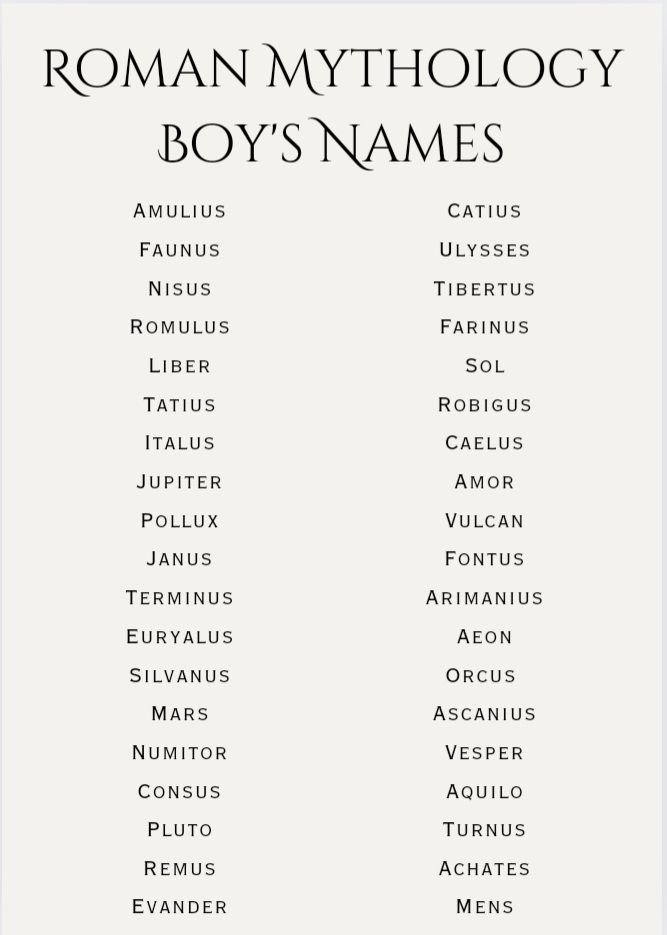
Step into the grandeur of ancient Rome, a civilization that not only built an empire but also forged a rich tapestry of gods, goddesses, and legendary figures whose names still echo with power and beauty today. Delving into Mythological & Divine Roman Names isn't just a historical exercise; it's an exploration of foundational stories, virtues, and even the cosmos itself. These names offer a unique blend of strength, elegance, and deep meaning, making them a timeless source of inspiration for everything from literary characters to beloved family members.
Whether you're an aspiring parent, a writer seeking the perfect moniker, or simply a history enthusiast, understanding these names opens a portal to the heart of Roman identity.
At a Glance: Your Guide to Roman Names
- Divine Inspiration: Discover names rooted in the Roman pantheon, from Jupiter to Venus, each carrying immense weight and lore.
- Heroic Echoes: Explore the legendary figures of Roman myth, including the founders of Rome and heroes of epic tales like Aeneas.
- Meaningful Choices: Uncover the etymological origins and symbolic significance behind each name, providing a deeper connection.
- Timeless Appeal: Learn why these ancient names remain popular and powerful choices in the modern world.
- Beyond the Gods: Understand how concepts like virtues, natural phenomena, and abstract ideas were personified and named in Roman culture.
Beyond the Colosseum: Why Roman Names Still Captivate
The Roman world, vast and influential, shaped much of Western civilization—from law and language to architecture and art. At its spiritual core lay a complex and expansive pantheon, a cosmic bureaucracy reflecting the Roman emphasis on order and governance. We're not talking about a handful of deities; the Roman pantheon, in its full scope, comprised 173 individual gods and spirits. The Godchecker database even lists 236 Roman deity names, including nicknames, titles, and honorifics. Each name is a thread in the rich fabric of their culture, interwoven with stories of creation, conflict, love, and the very founding of their mighty empire.
These aren't just names from dusty old texts; they are living legacies. They grace our planets, our months, and even our everyday vocabulary. When you choose a Roman name, you're not just picking a sound; you're invoking centuries of history, myth, and meaning. It's a way to connect with the gravitas and wisdom of a civilization that, for all its might, began with a whisper and a legend. For those looking to understand [the enduring influence of the Latin language](placeholder_link slug="latin-language-influence" text="the enduring influence of the Latin language"), Roman names are a perfect starting point.
The Divine Pantheon: Names of the Gods and Goddesses
The Roman gods were not distant, ethereal beings; they were intimately involved in daily life, overseeing everything from harvests and hearths to battles and births. Their names carry the weight of their domains, offering a powerful choice for those seeking a moniker with deep, symbolic resonance.
The Olympians' Roman Cousins: Major Deities
These are the heavy hitters, the deities whose Greek counterparts are often better known, but whose Roman identities solidified their place at the heart of the empire.
- Jupiter (Jove): The supreme god of the Roman pantheon, equivalent to the Greek Zeus. His name, from Indo-European Dyēws-pətēr ("father"), signifies his role as father of gods and men, presiding over the heavens, light, and the Roman state. A name of unparalleled authority.
- Juno: Wife of Jupiter and queen of the heavens, Juno was the protectress of marriage, women, and the state's finances. Her name embodies regal power and maternal strength.
- Mars: Possibly related to Latin mas ("male"), Mars was the formidable god of war, often equated with the Greek Ares. He was also an important agricultural deity and, critically, the divine father of Romulus and Remus. A name symbolizing strength and protection.
- Minerva: The Roman goddess of wisdom, war, and strategic battle, analogous to the Greek Athena. Her name may derive from Latin mens ("intellect"), embodying intelligence and martial prowess.
- Venus: Meaning "love, sexual desire," Venus was the goddess of love, beauty, and fertility, assimilated with Aphrodite. As the mother of Aeneas, she was revered as an ancestor of the Roman people. A name synonymous with charm and grace.
- Neptune: The majestic god of the sea, equivalent to the Greek Poseidon. His name, Neptunus, conjures images of vast oceans and untamed power.
- Ceres: From the Indo-European root ker ("grow, increase"), Ceres was the crucial Roman goddess of agriculture, grain, and fertility, the Roman Demeter. A nurturing and vital name.
- Diana: Meaning "divine, goddess-like," Diana was a powerful goddess of the moon, hunting, forests, and childbirth, often identified with Artemis. A name suggesting independence and wild beauty.
- Vulcan: The Roman god of fire, volcanoes, metalworking, and craftsmanship, later equated with Hephaestus. His name, Vulcanus, speaks of intense heat and creative skill.
- Vesta: A Roman cognate of Hestia, Vesta was the revered goddess of the hearth, home, and family, symbolized by a continuous sacred fire tended by the Vestal Virgins. A name evoking warmth, stability, and sanctity.
- Mercury: Derived from Latin mercari ("to trade"), Mercury was the swift god of trade, merchants, and travelers, later equated with Hermes. A name suggesting quick wit and communication.
Nature's Guardians & Abstract Powers: Lesser Deities & Personifications
The Roman pantheon extended far beyond the main Olympians, embracing a multitude of specialized deities and personifications of abstract concepts, natural phenomena, and human virtues. These names offer a nuanced connection to Roman thought and daily life.
- Amor: Meaning "love" in Latin, this was another name for the Roman god Cupid, personifying passion and desire.
- Angerona: The Roman goddess of the winter solstice, death, and silence. Her name may derive from Latin angor ("strangulation, torment"), a deeply evocative and mysterious choice.
- Aurora: Meaning "dawn" in Latin, she was the beautiful Roman goddess of the morning, painting the sky with light. A name of new beginnings and beauty.
- Auster: Meaning "south" in Latin, he was the Roman god of the south wind, bringing warmth or storms.
- Bellona: Derived from Latin bello ("to fight"), she was the fierce Roman goddess of war and a companion of Mars. A strong, martial name.
- Cardea: From Latin cardo ("hinge, axis"), she was the Roman goddess of thresholds, door pivots, and change, protecting homes.
- Carmenta: From Latin carmen ("song, poem, enchantment"), she was a Roman goddess of prophecy and childbirth, credited with inventing the Latin alphabet. A name for a creative and insightful spirit.
- Clementia: A Latin name meaning "mercy, clemency," she was the Roman personification of mercy, representing compassion and forgiveness.
- Concordia: Meaning "harmony" in Latin, she was the Roman goddess of harmony and peace, a foundational virtue for the state.
- Consus: Possibly from Latin consero ("to sow, to plant"), he was a Roman god of the harvest and grain, a deity of sustenance.
- Cupid: From Latin Cupido ("desire"), the Roman god of love, son of Venus and Mars, known for his bow and arrows.
- Discordia: Meaning "discord, strife" in Latin, she was the Roman goddess of discord, equivalent to the Greek Eris. A name reflecting chaos or conflict.
- Fauna: The feminine form of Faunus, a Roman goddess of fertility, women, and healing.
- Faunus: Possibly meaning "to befriend," a Roman god of fertility, forests, and agriculture.
- Felicitas: A Latin name meaning "good luck, fortune," she was the Roman personification of good luck and prosperity.
- Flora: Derived from Latin flos ("flower"), she was the Roman goddess of flowers and spring, symbolizing blooming and new life.
- Fortuna: Meaning "luck" in Latin, she was the Roman personification of luck, destiny, and fate. A name of chance and opportunity.
- Fulgora: From Latin fulgur ("lightning"), she was the Roman goddess who presided over lightning, a powerful and striking name.
- Invidia: Meaning "envy" in Latin, she was the Roman goddess of vengeance, equivalent to the Greek Nemesis.
- Janus: Meaning "archway" in Latin, he was the unique Roman god of gateways, beginnings, transitions, and endings, often depicted with two faces. The month of January is named for him. A name of foresight and retrospect.
- Juturna: The Roman goddess of fountains and springs, sister of Turnus, symbolizing pure water.
- Juventas: Meaning "youth" in Latin, she was the Roman goddess of youth, equivalent to the Greek Hebe. A name of vigor and freshness.
- Larunda (Lara): A talkative water nymph whose story involved Jupiter and Mercury, ultimately leading to her children becoming the Lares, household gods.
- Laverna: The Roman goddess of thieves and thievery, a name with a darker, more intriguing edge.
- Levana: From Latin levo ("to raise, to lift"), she was a Roman goddess associated with newborn babies and childbirth rituals, specifically the lifting of the child.
- Liber: Derived from Latin liber ("free"), he was a Roman fertility god, often identified with Dionysus, representing freedom and revelry.
- Libertas: Meaning "freedom, liberty" in Latin, she was the Roman personification of liberty, a powerful civic ideal.
- Libitina: The Roman goddess of funerals, corpses, and death, a somber but significant name.
- Lucina: Derived from Latin lucus ("grove") and later associated with lux ("light"), she was a Roman goddess of childbirth, bringing newborns into the light.
- Luna: Meaning "the moon" in Latin, she was the Roman goddess of the moon, often depicted driving a white chariot. A celestial, serene name.
- Maia: From Greek maia ("good mother") or possibly Latin maior ("greater"), a Roman goddess of spring and companion of Vulcan, after whom the month of May is named. A name of growth and warmth.
- Naenia: Meaning "incantation, dirge" in Latin, she was the Roman goddess of funerals and laments.
- Nona: Derived from Latin nonus ("ninth"), referring to pregnancy, she was a Roman goddess of pregnancy and one of the three Fates (Parcae), symbolizing destiny.
- Nox: Meaning "night" in Latin, she was the Roman goddess of the night, equivalent to the Greek Nyx. A name of mystery and darkness.
- Ops: Meaning "power, strength, wealth, abundance" in Latin, she was the wife of Saturn and mother of several gods, a goddess of harvest and prosperity.
- Pax: Meaning "peace" in Latin, she was the Roman goddess of peace, a profound and universally desired virtue.
- Pluto: A Latinized form of Greek Plouton ("wealth"), an alternate name for Hades, god of the underworld. A name of hidden depths and riches.
- Pomona: From Latin pomus ("fruit tree"), she was the Roman goddess of fruit trees, orchards, and gardens. A name of abundance and natural beauty.
- Proserpina: Meaning "to emerge" in Latin, she was the Roman equivalent of Persephone, goddess of the underworld and spring. A name of transition and rebirth.
- Quirinus: A Sabine and Roman god, sometimes identified with Romulus, possibly from quiris ("spear"). A name of ancient Roman identity and power.
- Salacia: Derived from Latin sal ("salt"), she was the Roman goddess of salt water, wife of Neptune. A name evoking the sea's vastness.
- Saturn: From Latin Saturnus, he was the father of Jupiter and Juno, and the Roman god of agriculture, wealth, and time (often linked to Cronus). A name of ancient wisdom and cycles.
- Silvanus: From Latin silva ("wood, forest"), he was the Roman god of forests, wild fields, and nature. A name connected to the wilderness and untamed beauty.
- Spes: Meaning "hope" in Latin, she was the Roman personification of hope, a fundamental human emotion and virtue.
- Summanus: Meaning "before the morning," he was the Roman god of the night sky and night lightning, a nocturnal counterpart to Jupiter. A name of celestial power in darkness.
- Terminus: Meaning "limit, boundary, end" in Latin, he was the Roman god of boundaries, overseeing property and order. A name of definition and limits.
- Veritas: Meaning "truth" in Latin, she was the Roman goddess and personification of truth, a name of profound honesty and integrity.
- Victoria: Meaning "victory" in Latin, she was the Roman goddess of victory, a celebrated and powerful name for achievement.
- Vesper: A Latin cognate of Hesperos, referring to the evening star.
These names offer a window into the Roman worldview, where abstract concepts were tangible deities, and every aspect of life had its divine overseer. To [gain insights into ancient Roman daily life](placeholder_link slug="ancient-roman-culture-daily-life" text="gain insights into ancient Roman daily life"), understanding these myriad deities is essential.
Echoes of Legend: Roman Heroes and Mythic Figures
Beyond the gods, Roman mythology is rich with heroes, founders, and tragic figures whose stories shaped their identity and ideals. These names carry the weight of epic tales, personal virtues, and monumental destinies.
- Aeneas: A Latin form of the Greek name Aineias ("praise"). The central hero of Virgil's Aeneid, son of Aphrodite, who traveled to Italy after the fall of Troy and founded the Roman state. A name of epic destiny and resilience.
- Amulius: In Roman mythology, he overthrew his brother Numitor, king of Alba Longa, setting the stage for Romulus and Remus. A name tied to usurpation and eventual justice.
- Anchises: Likely from Greek anchi ("near, close by, resembling"). A lover of Aphrodite and father of Aeneas, a figure of familial importance and divine connection.
- Ascanius: Also known as Julus, he was the son of Aeneas, a key figure in the founding lineage of Rome. A name of royal heritage.
- Camilla: A legendary warrior maiden of the Volsci, featured in Virgil's Aeneid, known for her speed and prowess in battle. A name of fierce independence and strength.
- Dido: Also called Elissa, she was the tragic queen of Carthage in Virgil's Aeneid, whose love for Aeneas led to her demise. A name of passion and sorrow.
- Euryalus: In Virgil's Aeneid, a loyal friend of Nisus, known for his bravery and ultimately his tragic death. A name representing friendship and sacrifice.
- Evander (Evandrus): A Latin form of Greek Euandros ("good of man"), an Arcadian hero who founded Pallantium, near the future site of Rome, and allied with Aeneas. A name of good character and foundational spirit.
- Gemini: Meaning "twins" in Latin, this refers to the mythological twin sons of Leda, Castor and Pollux, often associated with the constellation. A name symbolizing duality and brotherhood.
- Hercules: The usual Latin form of the Greek Heracles, renowned for his strength and twelve labors. An iconic name of immense power.
- Hersilia: In Roman legend, a Sabine woman who became the wife of Romulus, symbolizing the union of peoples in early Rome. A name of peace and integration.
- Italus: Meaning "of Italy" in Latin. In Roman legend, he was the father of Romulus and Remus and supposedly gave his name to Italy. A foundational name for the land itself.
- Lavinia: In Roman legend, the daughter of King Latinus, wife of Aeneas, and an ancestor of the Roman people. Aeneas named Lavinium in her honor. A name of lineage and legacy.
- Lucretia: A maiden in Roman legend whose rape by the king's son caused an uproar and led to the overthrow of the monarchy, symbolizing purity and the call for justice. A name of profound historical impact.
- Nisus: In Virgil's Aeneid, a Trojan and devoted friend of Euryalus, both slain during a heroic but ill-fated raid. A name of loyalty and courage.
- Numitor: In Roman mythology, the rightful king of Alba Longa, grandfather of Romulus and Remus, eventually reinstated. A name of rightful authority.
- Pollux: A Roman form of Greek Polydeukes ("very sweet"), the twin brother of Castor and a son of Zeus. A name of strong fraternal ties.
- Remus: In Roman legend, the twin brother of Romulus, co-founder of Rome, tragically slain by his brother. His name may be from Old Latin yemos ("twin"). A name of shared beginnings and tragic ends.
- Rhea Silvia: In Roman mythology, the mother of Romulus and Remus, a Vestal Virgin divinely impregnated by Mars. A name of sacred motherhood and destiny.
- Romulus: From Roma, the Latin name of the city, combined with a diminutive suffix. The legendary founder of Rome, twin son of Rhea Silvia and Mars, who killed Remus and established the city. The ultimate name for a Roman leader.
- Silvia: The feminine form of Silvius, prominently known through Rhea Silvia. A name associated with forests and ancient lineage.
- Thisbe: In a Greek legend (from Ovid's Metamorphoses), a young Babylonian woman whose tragic love story led to her suicide. A name of romantic tragedy.
- Turnus: In Virgil's Aeneid, a king of the Rutuli who led the Latins in war against Aeneas, ultimately killed by him in a duel. A name of proud resistance.
- Ulysses: The Latin form of Odysseus, the cunning Greek hero of the Trojan War and the Odyssey. A name of intelligence and perseverance.
These heroes, whether historical or mythological, embody the virtues and struggles that Romans admired, from courage and loyalty to piety and political cunning. To learn more about [famous Roman legends](placeholder_link slug="famous-roman-legends" text="famous Roman legends"), studying these figures is paramount.
More Than Just a Name: Deciphering Roman Meanings
What makes these names so enduring is not just their sound, but the stories and concepts embedded within them. Many Roman names have clear Latin roots, providing immediate insight into their meaning. For instance, Victoria literally means "victory," and Pax means "peace." Others, like Ceres (from "grow, increase") or Fortuna ("luck"), subtly hint at their domain or a desired quality.
Then there are the names borrowed or adapted from Greek mythology, like Aeneas or Ulysses, which carry the weight of Homeric epics but were fully integrated into the Roman narrative. These linguistic connections show us how the Romans selectively adopted and adapted elements from other cultures, weaving them into their own unique identity. Understanding these etymologies allows you to not just choose a name, but to choose a story and a meaning. Delving into [the deep roots of Latin names](placeholder_link slug="latin-etymology-guide" text="the deep roots of Latin names") often reveals surprising insights into Roman culture.
Choosing a Name with Ancient Resonance: Practical Considerations
You're inspired, perhaps even captivated, by the gravitas and beauty of these mythological and divine Roman names. Now, how do you go about selecting one for your own child, a beloved pet, a powerful character, or even a brand?
Here are some practical considerations to guide your choice:
- Sound and Flow: Say the name aloud. How does it sound with your surname? Does it roll off the tongue? Roman names often have strong, clear sounds.
- Meaning Matters: The beauty of these names lies in their inherent meaning. Do you want to evoke strength (Mars, Hercules), wisdom (Minerva), peace (Pax), or love (Venus, Amor)? Consider the virtues or qualities you wish to bestow.
- Uniqueness vs. Familiarity: Some names, like Aurora or Diana, are quite familiar in modern English-speaking cultures. Others, such as Angerona or Laverna, are much rarer. Decide if you prefer a classic choice or something truly distinctive.
- Pronunciation Challenges: Be mindful of names that might be difficult to pronounce or spell for those unfamiliar with Latin. While Romulus is recognizable, Euryalus might require a few attempts.
- Potential Associations: While most Roman mythological associations are positive or historically rich, be aware of any that might be less desirable (e.g., Discordia for "discord" might not be ideal for a person).
- Historical Context: If you're a history buff, you might want to delve into [a deeper dive into Roman history](placeholder_link slug="roman-history-timeline" text="a deeper dive into Roman history") to ensure the name’s historical usage aligns with your intent. For example, understanding [traditional Roman naming conventions](placeholder_link slug="roman-naming-conventions" text="traditional Roman naming conventions") can add another layer of appreciation, even if you don't follow them strictly.
The beauty of these names is that they are both ancient and evergreen. They carry the weight of history but also offer a fresh, powerful option for today. When you're ready to explore a plethora of possibilities, you might even want to [Generate your Roman name](placeholder_link slug="name-generator-roman" text="Generate your Roman name") to see what ancient moniker speaks to you.
Common Questions About Roman Mythological Names
Navigating the world of ancient Roman names can raise a few common queries. Let's tackle them head-on.
Are all these names suitable for modern use?
Absolutely! Many, like Diana, Aurora, Luna, and Flora, are already popular and beloved in contemporary society. Others, like Mars, Jupiter, or Minerva, are less common but lend a powerful, unique flair. The suitability often comes down to personal taste, how they sound with a surname, and whether their mythological associations (if any) resonate positively with you. Rare names like Fulgora or Silvanus could be striking choices for those seeking something truly unique.
How similar are Roman and Greek mythological names?
There's significant overlap, as the Romans adopted much of the Greek pantheon and many of their heroes, often giving them new Latin names. Jupiter is Zeus, Juno is Hera, Mars is Ares, Minerva is Athena, Venus is Aphrodite, and Neptune is Poseidon. However, it's not a one-to-one swap. The Romans also had indigenous deities and concepts unique to their culture (like Janus, Vesta, or Quirinus) that don't have direct Greek equivalents. Moreover, even when the gods were similar, their stories and cults often took on uniquely Roman characteristics. Exploring [the fascinating parallels between Greek and Roman mythology](placeholder_link slug="greek-roman-mythology-comparisons" text="the fascinating parallels between Greek and Roman mythology") is a journey in itself.
What are some Roman names that represent strength?
Many Roman names inherently convey strength. Here are a few top picks:
- Mars: The god of war himself.
- Hercules: The epitome of physical power.
- Victoria: Meaning "victory."
- Minerva: Goddess of strategic war and wisdom.
- Jupiter: Supreme god of the heavens.
- Bellona: Goddess of war.
- Liber: Meaning "free," representing strength of spirit.
- Quirinus: A Sabine war god, often identified with Romulus.
These names carry an undeniable force, perfect for a strong character or individual.
Your Legacy in a Name: Embracing Roman Heritage
The names of ancient Rome's gods, goddesses, and legendary figures are more than just historical curiosities. They are vibrant testaments to a powerful civilization, imbued with rich meanings, epic stories, and a timeless appeal. From the celestial might of Jupiter to the earthly grace of Flora, each name offers a unique narrative and a distinctive character.
By choosing one of these names, you're not just picking a label; you're inviting a piece of ancient history, myth, and profound meaning into your modern world. It's a way to honor the legacy of one of humanity's greatest empires and to connect with virtues, stories, and cosmic forces that have resonated for millennia. So go forth, explore these incredible names, and find the one that speaks to your soul, ready to carry its ancient resonance into a new era.